CosmoLex vs Clio: Which Is Better for Your Law Firm's Books?
Updated August 2026. Last verified August 29, 2026.
The old CosmoLex vs. Clio comparison used to be fairly simple.
Clio was the practice-management platform that connected to QuickBooks Online. CosmoLex was the all-in-one platform that replaced QuickBooks.
That is no longer accurate.
In 2026, Clio has built-in legal accounting, and CosmoLex now integrates with QuickBooks Online. That means a law firm can choose the legal platform and the accounting system separately instead of assuming the practice-management choice automatically determines where the general ledger has to live.
That change matters because, from the bookkeeping side, I do not think “one system” should automatically be the goal.
Practice-management-native accounting is designed around legal workflows. QuickBooks Online is designed around running the business.
Clio Accounting and CosmoLex native accounting can handle core bookkeeping functions. But for most of the law firms I work with, I still prefer QuickBooks Online as the general accounting system because it gives the bookkeeping team more flexibility to manage bank activity, expenses, revenue, reconciliations, account structure, and financial reporting.
That does not mean every firm using native Clio or CosmoLex accounting should move to QBO. It means that if I am helping design the financial system from scratch, I want a compelling reason before I give up the flexibility of QuickBooks solely to reduce the number of platforms.
The goal is not the fewest software platforms. The goal is the cleanest financial system.
Here is how I compare CosmoLex and Clio in 2026 from the bookkeeping side.
CosmoLex vs Clio: The Short Answer
Choose CosmoLex if legal accounting and trust-account workflows are central to the software decision and you prefer CosmoLex’s more accounting-first approach.
Choose Clio if you want the broader practice-management ecosystem, deeper third-party integrations, and more extensive workflow and AI functionality.
For the general accounting system, my default preference is still QuickBooks Online for most firms. Both Clio and CosmoLex can now work with QBO, which means the law firm can use the legal platform that fits its practice without giving up the accounting system that is easier to manage as a business.
Clio currently includes built-in legal accounting across its plans and supports external accounting integrations such as QuickBooks Online on Core and higher. Clio pricing and feature matrix
CosmoLex offers native legal accounting and a one-way QuickBooks Online integration on Core and Pro. CosmoLex QuickBooks integration
The Fundamental Difference Changed in 2026
When I originally compared these platforms, CosmoLex’s strongest accounting differentiator was easy to explain: CosmoLex had business accounting built in and Clio did not.
That is no longer the dividing line.
H3 - Clio’s Accounting Model
Clio’s current plans include built-in legal accounting. Its current feature matrix includes bank-account sync, accounts receivable, chart of accounts, expense and vendor management, trust and operating reconciliation, financial reporting, check printing, cash- and accrual-basis reporting, and automatic transaction matching.
Firms that prefer an outside accounting platform can still connect QuickBooks Online on Clio Core and higher plans. View Clio’s current plans
H3 - CosmoLex’s Accounting Model
CosmoLex remains more accounting-first. Core includes trust accounting and ledgers, compliance reporting, bank reconciliation, and financial reporting. Pro adds General Ledger & Payables, bank feeds, and advanced compliance reporting.
CosmoLex also supports QuickBooks Online on Core and Pro. The integration runs one way from CosmoLex to QBO. View CosmoLex pricing
That creates four legitimate configurations in 2026:
Clio + built-in accounting
Clio + QuickBooks Online
CosmoLex native accounting
CosmoLex + QuickBooks Online
The software decision and the general-ledger decision are now related, but they are not the same decision.
CosmoLex vs Clio: Quick Comparison
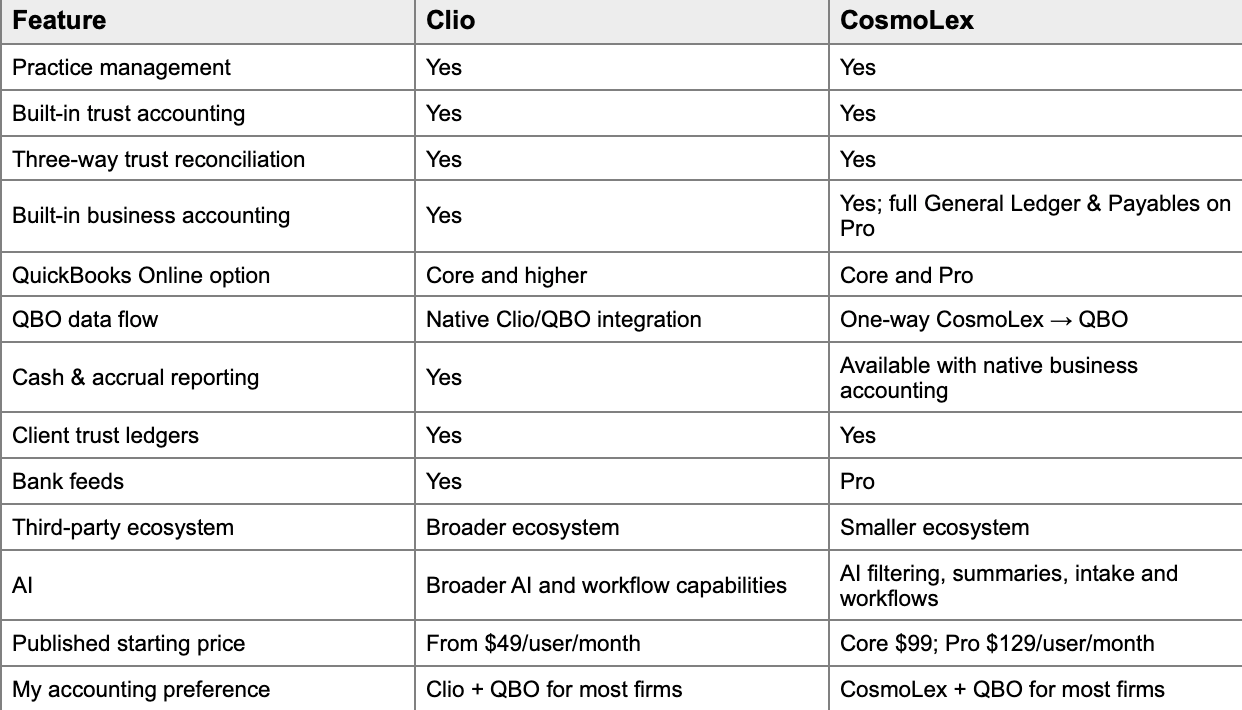
Important: The last row is my professional preference based on bookkeeping workflow - not a software feature claim.
Trust Accounting: Much Closer Than It Used to Be
I previously gave CosmoLex a clearer edge on trust accounting. I no longer think that is a fair blanket statement because both platforms now support a true three-way reconciliation workflow.
CosmoLex Trust Accounting
Trust accounting has been part of CosmoLex’s core identity for years. CosmoLex maintains individual client trust ledgers and provides a dedicated Three-Way Reconciliation Report that compares the reconciled bank balance, the CosmoLex book balance, and the individual client trust-ledger balances.
The trust bank account must first be reconciled before the three-way report can be generated. CosmoLex three-way reconciliation documentation
Clio Trust Accounting
Clio Accounting also performs three-way reconciliation for trust accounts, comparing bank records, client trust ledgers, and the firm trust ledger. Its reconciliation workflow identifies uncleared transactions and produces reconciliation reports after completion.
Clio operating and trust reconciliation documentation
My Bookkeeping Take
I would not choose between Clio and CosmoLex based only on whether either platform “has three-way reconciliation.” They both do.
I would look at the firm’s actual trust workflow: how much trust activity it has, how client ledgers are maintained, who performs the reconciliation, where the general ledger lives, how outstanding items are investigated, and how the bookkeeping team will independently verify that the records agree.
Software can produce the reconciliation report. The underlying transactions and client balances still have to be correct.
Trust Account Reconciliation for Law Firms
Accounting and Bookkeeping: Where I Prefer QuickBooks Online
Practice-management-native accounting is designed around legal workflows. QuickBooks Online is designed around running the business.
That distinction is the biggest change I would make to my original comparison.
Clio Accounting and CosmoLex native accounting can handle the core bookkeeping functions a law firm needs. On paper, putting everything in one system sounds ideal. In practice, I often find the native accounting environments more constrained than QuickBooks Online.
There is less flexibility in how I can work with the books. Reporting is more limited. Investigating transactions can take more steps. Adjusting the account structure or reviewing activity from different financial angles is not as fluid. The legal platform is trying to serve practice management and accounting at the same time, and the accounting side does not give me the same range of tools I have in QBO.
QuickBooks Online gives the bookkeeping team more room to manage the operating side of the firm: bank activity, expenses, revenue streams, reconciliations, balance-sheet accounts, vendors, payroll connections, and financial reporting. Bank feeds are familiar. Transaction review is easier. Account-level activity is easier to inspect. And most outside CPAs already know the system.
For that reason, if I were designing the accounting system for most law firms today, I would generally choose Clio + QBO or CosmoLex + QBO over the native accounting option.
That is a preference, not a rule. If a firm already uses Clio Accounting or CosmoLex native accounting and the books are working well, I would not recommend a migration solely because I personally prefer QBO. And some firms genuinely value keeping the accounting inside one platform more than they value the additional flexibility.
But I would not move a clean, established QBO file into a practice-management-native accounting system merely to say the firm now has “one system.” Fewer systems do not automatically mean less bookkeeping work.
The goal is not the fewest software platforms. The goal is the cleanest financial system.
Clio: Where It Has the Advantage
As a practice-management platform, I still give Clio the overall advantage for firms that want a broad legal-tech ecosystem.
Clio’s current plans combine matter management, billing, calendaring, documents, client communication, payments, accounting, reporting, and a large integration ecosystem. Core and higher also support external accounting integrations such as QuickBooks Online.
I particularly like the ability to keep Clio as the legal operating system while using QBO for the broader business accounting. The practice-management team can live in Clio. The bookkeeping and financial-management workflow can live primarily in QBO. The integration carries the data between them.
Where I Give Clio the Edge
Broader third-party integration ecosystem
More extensive practice-management and workflow capabilities
Broader AI functionality
Larger consultant and support ecosystem
A mature Clio + QuickBooks Online workflow
CosmoLex: Where It Has the Advantage
CosmoLex remains particularly compelling when accounting and trust accounting are central to the legal-software decision.
Its trust-accounting architecture is mature, client trust ledgers and reconciliation are central to the platform, and the product was built with legal financial workflows in mind rather than adding them later.
The 2026 QBO integration also removes one of my biggest historical objections to CosmoLex. A law firm can choose CosmoLex for matter management, billing, and trust accounting without automatically giving up QuickBooks Online for the operating books.
For me, that makes CosmoLex much more attractive than when the decision was effectively “use CosmoLex accounting or do not use CosmoLex.”
Where CosmoLex Is Particularly Compelling
Trust-accounting-first architecture
Client-level trust ledgers and established three-way reconciliation workflow
Strong connection between matters, billing, trust activity, and legal financial records
Choice between native accounting and QuickBooks Online
A more consolidated legal-financial workflow for firms that value that structure
AI: Both Platforms Have It Now
The original article said CosmoLex did not have comparable AI tools. That is outdated.
CosmoLex now has AI functionality including natural-language filtering, document summarization, AI-assisted intake-form creation, and AI workflow functionality.
CosmoLex AI practice-management demo
Clio currently has the broader AI footprint across practice administration and legal work, so I still give Clio the advantage on AI breadth. But I would no longer describe CosmoLex as a platform without meaningful AI.
CosmoLex vs Clio Pricing in 2026
Clio Pricing
Clio’s current U.S. plans are Starter, Core, Signature, and Elite. Clio currently publishes a starting price of $49 per user/month for Starter and directs firms to request current pricing for the higher tiers.
CosmoLex Pricing
As of August 29, 2026, CosmoLex lists Core at $99 per user/month and Pro at $129 per user/month for monthly billing. Annual billing currently saves $120 per user per year.
Which Is Cheaper?
I would not declare a universal winner.
Total cost depends on the Clio tier, whether the firm uses Clio’s accounting or QBO, whether the firm needs CosmoLex Core or Pro, whether CosmoLex uses native accounting or QBO, the number of users, and the other applications the firm needs.
And I would not choose the accounting architecture based on subscription cost alone. A cheaper software stack can become more expensive if the bookkeeping workflow takes materially longer every month
Which Platform Should Your Firm Choose?
Choose CosmoLex if:
Trust accounting and legal financial workflows are major factors in the software decision.
You prefer CosmoLex’s accounting-first legal architecture.
You want the option to use CosmoLex with QuickBooks Online.
Your firm does not depend on a large number of niche third-party integrations.
You want matter, billing, and trust records closely connected inside the legal platform.
Choose Clio if:
You want the broader legal practice-management ecosystem.
Your firm relies on multiple outside applications and integrations.
AI and workflow automation are major priorities.
Your firm already has a strong Clio workflow.
You want a mature Clio + QuickBooks Online configuration.
If you're also considering Smokeball, read our Clio v Smokeball comparison.
Read our full CosmoLex review.
For the Accounting Layer
Unless there is a compelling reason to keep the general ledger inside the legal platform, my default preference for most firms is QuickBooks Online.
That means I am often choosing between Clio + QBO and CosmoLex + QBO - not between Clio and CosmoLex based on which one can replace QuickBooks.
What I Tell Law Firms Comparing CosmoLex and Clio
I would not start with, “Which software has accounting built in?” Both do.
I would ask:
Which legal workflow fits the attorneys and staff better?
How much trust activity does the firm have?
Where should the general ledger live?
Who will be responsible for the books every month?
Does the CPA or accounting team need QuickBooks Online?
Which reports does ownership actually use to run the business?
How many outside applications need to connect to the legal platform?
If the firm already has a clean, established QuickBooks Online workflow, I need a good reason to move the general ledger solely for the sake of an all-in-one setup.
If the firm strongly prefers keeping everything in Clio Accounting or CosmoLex native accounting, I can work with that too. I just want the firm to understand the tradeoff: fewer systems can mean a more consolidated workflow, but the accounting environment may be more constrained.
Practice-management-native accounting is designed around legal workflows. QuickBooks Online is designed around running the business.
That is ultimately how I separate the two jobs.
For a broader view of all the options, read my full guide: Best Accounting Software for Law Firms.
Frequently Asked Questions
-
Yes. CosmoLex offers a one-way QuickBooks Online integration on Core and Pro. The firm can keep legal and trust workflows in CosmoLex while using QBO as the general accounting system.
-
No. Clio now includes built-in legal accounting. Firms that prefer QBO can still integrate QuickBooks Online on Core and higher plans.
-
Yes, if the firm uses the native accounting configuration and the plan supports the accounting functions it needs. I would still compare that setup against CosmoLex + QBO before deciding, because my preference for most firms is to keep the broader business accounting in QuickBooks Online.
-
Both now support three-way trust reconciliation. I would compare the complete monthly trust workflow, the quality of the underlying client ledgers, and how the bookkeeping team verifies the records rather than choosing solely because one platform advertises trust accounting.
-
Both can work. Clio has an established QBO integration, and CosmoLex now offers a one-way QBO integration. The better choice depends on which legal platform fits the firm’s practice while allowing the bookkeeping team to maintain a clean general ledger in QBO.
-
Not necessarily. A single system can reduce integration points, but it can also limit the bookkeeping team if the accounting tools are less flexible. For most firms I work with, I prefer the broader financial-management capabilities of QuickBooks Online. The goal is not the fewest systems; it is the cleanest financial system.
-
Yes. CosmoLex now has AI features including natural-language filtering, document summarization, intake-form creation, and workflow functionality. Clio currently has a broader AI offering, but it is no longer accurate to say CosmoLex lacks meaningful AI.
-
Not necessarily. Total cost depends on the specific plan, user count, accounting configuration, and other software the firm needs. I would also consider the ongoing bookkeeping workload, not just the subscription price.
Already Using Clio or CosmoLex?
The software is only one part of the financial system.
Accounting Atelier specializes in bookkeeping for law firms, including firms using Clio, CosmoLex, MyCase, and QuickBooks Online.
Our work includes monthly bookkeeping, trust-account bookkeeping, three-way reconciliation, trust-account cleanup, and financial reporting.
If your firm uses Clio or CosmoLex and needs someone who understands how the practice-management records connect to the books, learn more about our law firm bookkeeping services.
About the Author
Amy Coats is the founder of Accounting Atelier, a bookkeeping firm specializing in law-firm bookkeeping, trust accounting, and financial management.
She has 25+ years of accounting and financial-management experience, with specialized expertise in law-firm bookkeeping.
Amy is a QuickBooks Online ProAdvisor, and Accounting Atelier is a Clio Certified Partner, MyCase Partner, and CosmoLex Partner.
Amy and her team work with law firms using Clio, CosmoLex, MyCase, QuickBooks Online, and other legal financial systems, providing monthly bookkeeping, trust-accounting support, three-way reconciliation, cleanup, and financial reporting.
→ Need help with your law firm's books? Learn about our services.