Law Firm Bookkeeping Cleanup: How to Fix Messy Books
Updated June 2026
By Amy Coats | Founder of Accounting Atelier | 25+ years in bookkeeping, specializing in IOLTA trust accounting for solo and small law firms
Law firm bookkeeping cleanup reconstructs financial records that have fallen behind, been handled incorrectly, or never existed in proper form. Unlike ongoing bookkeeping services that maintain current records, cleanup projects fix historical problems: backlogged reconciliations, trust accounting gaps, miscategorized transactions, and documentation missing from prior periods.
Trust account cleanup is one of the most common reasons firms need bookkeeping work. Trust accounting issues ranked among the top three lawyer complaint categories in Florida in 2024, according to The Florida Bar. In California, the State Bar's Client Trust Account Protection Program (CTAPP) launched mandatory annual reporting in 2023; the most frequent compliance issue State Bar auditors identify is law firms not performing monthly three-way reconciliation. Both findings point at the same gap: trust records that haven't been maintained properly. Cleanup is how firms close that gap before a bar audit forces it.
Cleanup becomes necessary when firms change bookkeepers, prepare for audits or transactions, or discover their existing records don't meet compliance standards. The scope ranges from minor catch-up work to complete reconstruction depending on how long problems accumulated and how severe the gaps are.

When Law Firms Need Bookkeeping Cleanup
Trust account cleanup specifically becomes mandatory when prior records can't satisfy your state bar's requirements. California Rule 1.15(d)(3) requires monthly reconciliation of account journals, client ledgers, and bank statements, with five-year retention. Florida Rule 5-1.2(d)(1) requires monthly reconciliation plus a monthly comparison between reconciled bank balances and total trust ledger cards. New York Rule 1.15(d) requires seven-year retention of trust account records. Texas Rule 1.14 requires record preservation for five years after representation ends. Cleanup brings records back into alignment with these standards.
Several situations trigger cleanup projects:
Changing Bookkeeping Providers
New bookkeepers inherit whatever the previous provider left behind. If records are incomplete, reconciliations are backlogged, or trust accounting documentation is missing, cleanup must happen before ongoing service can begin on solid footing.
Bar Audit or Compliance Review
Bar auditors examine trust records going back years. If three-way reconciliation wasn't performed monthly, client ledgers don't exist, or documentation has gaps, cleanup becomes urgent. Reconstructing records before auditors arrive is far better than attempting explanations during the audit.
Firm Sale or Partner Changes
Buyers and new partners conduct financial due diligence. Messy books delay transactions, reduce valuations, and sometimes kill deals entirely. Cleanup demonstrates financial discipline and provides the documentation due diligence requires.
Tax Preparation Problems
CPAs preparing returns need accurate records. When books are incomplete or unreliable, tax preparation becomes expensive guesswork. Cleanup before tax season prevents extensions, amended returns, and potential audit triggers.
Discovery of Problems
Sometimes firms simply realize their books aren't right. Trust balances don't match expectations. Financial reports don't make sense. Questions arise that existing records can't answer. Recognition of problems is the first step toward fixing them.
What Cleanup Actually Involves
Cleanup work usually takes place across multiple platforms. For solo and small law firms, the most common cleanup environments are QuickBooks Online (the operating books) combined with one practice management system: Clio Manage, MyCase, or CosmoLex. LeanLaw cleanup works inside QuickBooks Online directly. The bookkeeper has to reconcile both systems against each other, against the bank, and against individual client ledgers. Three-way reconciliation gets harder when the trust ledger lives in one system and the operating books live in another.
Cleanup scope varies based on what's broken and how long it's been broken. Most projects include some combination of these elements:
Trust Account Reconstruction
Trust accounting problems are the most serious and often the most labor-intensive to fix. Reconstruction may include:
Building client ledgers that never existed
Recreating three-way reconciliation documentation for prior months
Identifying and documenting historical discrepancies
Tracing trust transactions to proper client matters
Separating commingled funds if operating and trust were mixed
Trust cleanup is not optional for firms holding client funds. IOLTA compliance requires documentation that can withstand bar scrutiny. If that documentation does not exist, creating it is the cleanup priority. A complete list of what auditors expect is covered in our trust account compliance records guide.
Reconciliation Catch-Up
Monthly reconciliation of bank accounts, credit cards, and trust accounts should happen every month. When it doesn't, backlogs accumulate. Cleanup means working through each missed month:
Obtaining historical bank statements
Matching transactions to accounting records
Identifying and researching discrepancies
Documenting reconciliation for each period
Correcting errors discovered during the process
The further behind reconciliation falls, the harder catch-up becomes. Twelve months of backlog takes more than twelve times the effort of one month because transaction memory fades and documentation becomes harder to locate.
Transaction Categorization
Cleanup often reveals transactions that were never categorized, categorized incorrectly, or assigned to wrong accounts. Fixing this requires:
Reviewing uncategorized transactions and assigning proper accounts
Identifying and correcting miscategorized expenses
Separating personal and business transactions if mixed
Confirming trust transactions are properly distinguished from operating
Rebuilding chart of accounts if the existing structure doesn't fit law firm needs
Proper categorization enables accurate financial reporting. Without it, P&L statements and balance sheets don't reflect reality.
Historical Record Organization
Beyond transaction-level cleanup, firms often need broader record organization:
Locating and organizing source documents (invoices, receipts, statements)
Digitizing paper records for accessibility
Creating filing systems that support ongoing maintenance
Documenting procedures so problems don't recur
Organization work supports both the cleanup project itself and the ongoing bookkeeping that follows.
Cleanup Scope Assessment
Before cleanup begins, assessment determines what's actually needed. A thorough assessment examines:
Trust Accounts
Do three-way reconciliations exist for each month?
Are client ledgers maintained and accurate?
Can trust balances be traced to individual client matters?
Are there unexplained discrepancies or negative client balances?
Operating Accounts
Are bank reconciliations current?
How many months of backlog exist?
Are transactions properly categorized?
Does the chart of accounts fit law firm needs?
Documentation
Can source documents be located for significant transactions?
Are records organized and accessible?
What documentation gaps exist?
Systems
Is accounting software configured correctly for law practice?
Are trust and operating properly separated?
Can the current system produce required reports?
Assessment typically takes 2-4 hours and results in a cleanup proposal with defined scope, timeline, and cost estimate.
What Cleanup Costs
Cleanup pricing depends on three factors: how far behind records are, how messy the existing state is, and how much trust accounting reconstruction is required.
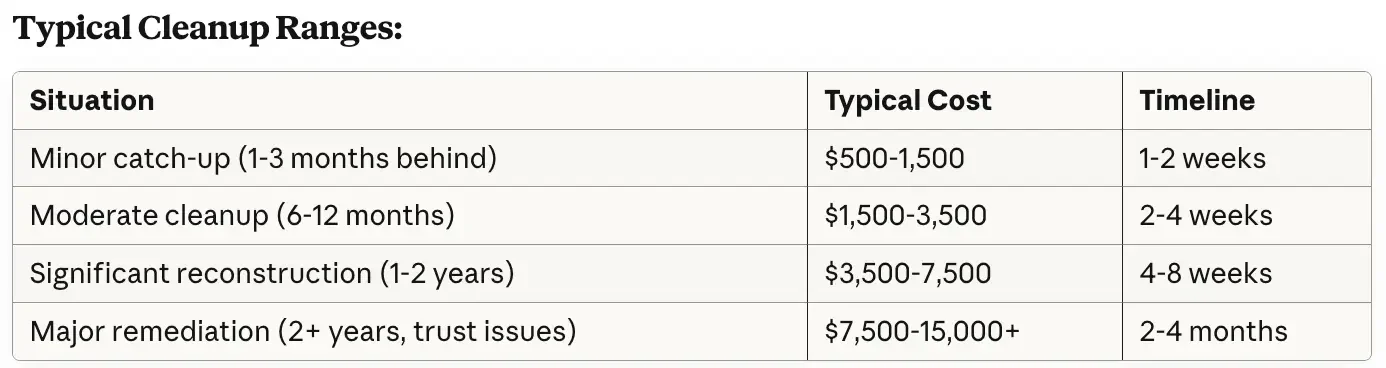
Trust accounting reconstruction adds significant cost because it requires transaction-by-transaction review, client ledger creation, and documentation that meets bar compliance standards.
What Affects Cost:
Transaction volume (more transactions = more work)
Number of bank accounts and credit cards
Trust account complexity and client count
Quality of existing records and documentation
Availability of source documents
Accounting software state and configuration
Most cleanup projects are billed as fixed-fee based on assessment findings. This provides cost certainty rather than open-ended hourly billing.
Behind on your books, or staring down a bar audit? Accounting Atelier rebuilds law firm books and trust records that hold up to bar scrutiny, then keeps them that way. See how trust account cleanup works → Trust Account Cleanup

DIY Cleanup vs. Professional Help
Some cleanup work can be handled internally. Other situations require professional expertise.
DIY Cleanup Can Work For:
Simple catch-up on reconciliations with good source documents
Transaction categorization when categories are clear
Basic organization of accessible records
Situations without trust accounting complexity
Professional Cleanup Is Necessary For:
Trust account reconstruction requiring compliance expertise
Complex reconciliation problems with multiple accounts
Significant historical gaps requiring forensic reconstruction
Situations where bar audit or compliance review is pending
Records so disorganized that assessment itself requires expertise
The DIY vs. professional decision often comes down to trust accounting. If trust records need reconstruction, legal bookkeeping specialists are essential because general bookkeepers don't know what bar compliance requires. Our guide on how to choose a law firm bookkeeper covers the specific qualifications to look for.
The Cleanup Process
Professional cleanup typically follows this sequence:
Phase 1: Assessment (Week 1)
Review current state, identify gaps, determine scope, and provide cleanup proposal with fixed-fee quote.
Phase 2: Document Gathering (Week 1-2)
Obtain bank statements, source documents, and any existing records needed to complete cleanup. Client provides access to accounting software and banking portals.
Phase 3: Reconciliation and Reconstruction (Weeks 2-6)
Work through backlogged periods, reconcile accounts, reconstruct trust documentation, and correct transaction categorization. This is the bulk of cleanup work.
Phase 4: Review and Documentation (Week 6-8)
Quality review of completed work, creation of summary documentation, and preparation of clean starting point for ongoing service.
Phase 5: Transition to Ongoing Service
Cleanup ends with books current and compliant. Ongoing bookkeeping begins from a clean foundation rather than inherited mess.
Timeline varies based on cleanup scope. Minor catch-up finishes in days. Major reconstruction takes months.
Preventing Future Cleanup Needs
Cleanup projects are expensive and stressful. Preventing recurrence requires:
Monthly Bookkeeping Discipline
Reconciliation, categorization, and reporting should happen every month without exception. Professional bookkeeping at $750-1,500/month costs far less than periodic cleanup projects.
Trust Accounting Protocols
Three-way reconciliation monthly. Client ledgers maintained continuously. Documentation created as transactions occur rather than reconstructed later. Trust accounting red flags addressed immediately rather than ignored.
Qualified Support
Whether in-house or outsourced, bookkeeping support must understand legal requirements. General bookkeepers create problems they do not recognize. Legal specialists who understand attorney trust account rules maintain compliance from the start.
Regular Review
Partners should review financial reports monthly rather than delegating and forgetting. Catching problems early prevents accumulation that requires cleanup later.
Red Flags That Suggest Cleanup Is Needed
If any of these describe your firm, cleanup should be on your agenda:
Bank reconciliations are more than 2 months behind
You can't produce a three-way trust reconciliation for last month
Your bookkeeper doesn't understand trust accounting requirements
Financial reports don't match your sense of how the business is performing
Your CPA asks for records you can't easily provide
You're preparing for bar audit, firm sale, or partner changes
You've changed bookkeepers and the transition revealed problems
Trust account balance doesn't match what client ledgers should show
Ignoring these signals allows problems to compound. Legal bookkeeping mistakes don't fix themselves - they accumulate until cleanup becomes unavoidable.
Questions to Ask Before Starting Cleanup
When engaging a cleanup provider, get clear answers:
What's included in the fixed fee? Understand scope boundaries and what might trigger additional charges.
What do you need from me? Know your responsibilities for providing access, documents, and information.
What's the timeline? Get specific milestones, not vague estimates.
How will you handle trust accounts? Ensure they understand IOLTA requirements and three-way reconciliation.
What will I have when cleanup is complete? Understand deliverables: reconciled accounts, trust documentation, organized records.
Do you offer ongoing service after cleanup? Cleanup without ongoing maintenance recreates the same problems. Integrated service prevents recurrence.
The Bottom Line
Law firm bookkeeping cleanup fixes problems that accumulated through neglect, inexperience, or inadequate systems. The work isn't glamorous, but it's essential when records don't meet compliance standards or support firm operations.
Cleanup costs less than the consequences of leaving problems unaddressed: failed bar audits, deal complications, tax problems, and the ongoing stress of running a firm on books you can’t trust. Firms that invest in cleanup and follow with proper ongoing bookkeeping services eliminate the cycle of accumulating problems and periodic crisis remediation.
If your books need cleanup, the best time to start was when problems began. The second best time is now - before problems compound further.
Start where the risk is. If your trust records can't survive a bar audit, that's the place to begin. Accounting Atelier handles the cleanup and the ongoing bookkeeping that keeps the problem from coming back. Book a cleanup assessment → Trust Account Cleanup
Frequently Asked Questions
-
Cleanup reconstructs financial records that have fallen behind or been handled incorrectly. This includes catching up backlogged reconciliations, rebuilding trust account documentation, correcting transaction categorization, and organizing historical records to meet compliance standards and support accurate reporting.
-
Cleanup typically costs $1,500-7,500 depending on how far behind records are and whether trust accounting reconstruction is needed. Minor catch-up runs $500-1,500. Major reconstruction involving years of backlog and trust account issues can exceed $10,000.
-
Timeline depends on scope. Minor catch-up finishes in 1-2 weeks. Moderate cleanup takes 2-4 weeks. Significant reconstruction requiring trust account work may take 2-4 months. Assessment before cleanup begins provides specific timeline estimates.
-
Simple catch-up on reconciliations with good documentation can be handled internally. However, trust account reconstruction requires legal bookkeeping expertise because general bookkeeping knowledge doesn't include bar compliance requirements. Professional help is essential for trust-related cleanup.
-
Common triggers include changing bookkeeping providers, preparing for bar audit or compliance review, firm sale or partner changes, tax preparation difficulties, or simply discovering that existing records are incomplete or unreliable.
-
Typical cleanup includes bank and trust account reconciliation catch-up, transaction categorization correction, trust documentation reconstruction, chart of accounts fixes, and record organization. Scope varies based on assessment findings.
-
Maintain monthly bookkeeping discipline with reconciliation, categorization, and reporting every month. Use qualified bookkeepers who understand legal requirements. Perform three-way trust reconciliation monthly. Review financial reports regularly rather than delegating and forgetting.
-
Usually yes. Providers who perform cleanup understand your firm's history and systems. Transitioning to ongoing service with the same provider ensures continuity and prevents the knowledge loss that occurs when switching providers.
-
Start with a cleanup assessment immediately. Auditors won't wait for perfect records, but you need a clear picture of what's broken before cleanup begins. Assessment identifies trust account reconstruction needs, quantifies reconciliation backlog, and determines whether cleanup can finish before auditors arrive. When facing imminent audits, cleanup needs to focus first on trust accounts, then work backward to reconcile operating accounts and organize supporting documentation. Even if cleanup can't complete entirely before audit, professional reconstruction work demonstrates good faith compliance efforts and provides auditors with documentation that wouldn't exist otherwise.